TB-7955 · REV E · Technical newsheet
Electronic TestDevice profile
8-Channel Oscilloscope Pairs 12-Core AMD EPYC, 96 GB RAM
An 8-channel oscilloscope built around a 12-core AMD EPYC CPU, 96 GB of system RAM, and a 15.6-inch display puts workstation-class compute inside a bench instrument. Key analog specs remain unpublished.
By Nathan Brooks3 min read545 words
Features
- 8 analog channels in the reported configuration
- 12-core AMD EPYC processor
- 96 GB of system RAM
- 15.6-inch integrated display
- Analog bandwidth, sample rate, vertical resolution, and trigger jitter specifications not yet disclosed
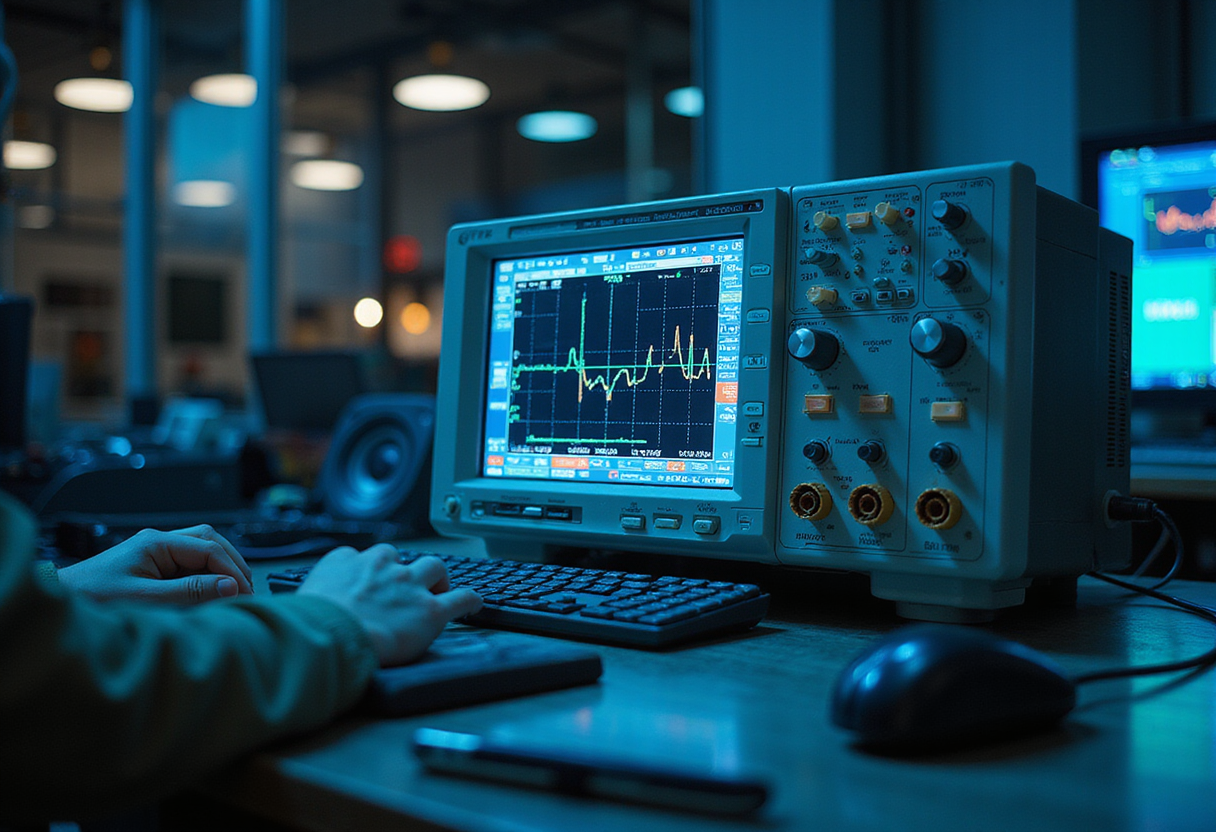
Eight channels, a 12-core AMD EPYC processor, 96 GB of system RAM, and a 15.6-inch display now ship inside a single oscilloscope chassis, in a configuration more typical of a workstation than a bench instrument.
What does EPYC-class compute bring to a scope?
Traditional oscilloscopes rely on application-specific SoCs sized for waveform capture, edge triggering, and on-screen rendering. They run short on memory and CPU throughput when engineers layer protocol decoding, eye-diagram analysis, and automated compliance scripts on top of acquisition.
An EPYC processor with 12 cores and 96 GB of system memory removes that bottleneck. Multi-million-point captures across eight analog channels — common in radar, power-electronics, and serial-bus validation — fit comfortably in RAM for post-processing without round-tripping to an external PC.
Why does the display size matter?
Bench oscilloscopes have historically shipped with 7- to 10-inch panels. A 15.6-inch diagonal matches a laptop workstation screen and gives engineers space to view eye diagrams, decode traces, and spreadsheets side by side without an external monitor.
The shift signals a vendor positioning toward labs where the scope replaces, rather than pairs with, a separate analysis PC.
What specifications remain unconfirmed?
The product coverage lists compute and display specifications but does not publish the four numbers that define an oscilloscope's measurement envelope: analog bandwidth, real-time sample rate, vertical resolution (typically 8-bit or 12-bit ADCs), and trigger jitter.
Without those, comparison against the current crop of 4 GHz / 12-bit and 8 GHz / 12-bit instruments from Keysight, Teledyne LeCroy, and Rohde & Schwarz is premature.
Which applications justify eight channels?
- Phased-array radar baseband validation
- Multi-lane PCIe, USB, or automotive Ethernet compliance
- Parallel SiC or GaN half-bridge switching characterization
- MCU debug combining analog, digital, and power-rail monitoring
- Aerospace and defense telemetry with redundant signal paths
These workloads generate more simultaneous channels and longer captures than 2- or 4-channel scopes can manage.
How does this differ from PXI-based acquisition?
PXI oscilloscope modules offload analysis to a separate chassis controller. Data buffers cross the PXI backplane on every acquisition, adding latency and consuming PXI slot budget.
Integrating EPYC compute inside the scope chassis collapses the acquisition-to-decision path into one box. Engineers no longer configure a separate analysis workstation, license server, and synchronization chain.
What compliance questions does this raise?
Buyers in regulated industries — automotive (ISO 26262), aerospace (DO-178C), medical (IEC 62304) — require traceable calibration. They will want to know:
- Published EN/IEC 61010 safety certification
- ISO 17025 calibration scope and interval
- Measurement uncertainty budget at rated bandwidth
- Whether software updates alter calibrated gain or timing paths
Integrating a general-purpose compute platform with acquisition hardware complicates change control. Vendors must demonstrate that firmware and OS updates do not perturb the analog front end's transfer function between calibration cycles.
The platform's adoption will hinge on whether it ships with the same accuracy class — typically ±0.5% of full scale for mid-range bench scopes — and the same calibration interval (one or two years) that established vendors maintain.
Until those numbers appear on the datasheet, the EPYC + 96 GB combination remains a promising but unverified entry in the high-channel-count oscilloscope market.
via Google News: Oscilloscopes and test equipment (Source)
Filed under
- oscilloscope
- amd-epyc
- 8-channel
- bench-instrument
- signal-acquisition
More from Nathan Brooks
Show full bio
Staff writer covering industry trends and analytics at Testbench Report.
55 articles