TB-6173 · REV A · Technical newsheet
Lab InstrumentationDevice profile
Teledyne FLIR's A8481 Brings HD MWIR Imaging to Science Benches
Teledyne FLIR's A8481 packs HD MWIR resolution into a compact science camera, promising finer thermal detail without changing existing optics, software, or lab workflows.
By Sophie Lindqvist2 min read491 words
Features
- Teledyne FLIR announced the A8481, a compact HD MWIR science camera
- Camera targets researchers needing more thermal detail without changing existing workflows, optics, software, or infrastructure
- Full measurement specifications such as NETD and frame rates are not yet published
- Positioned for scientific thermal analysis rather than industrial monitoring
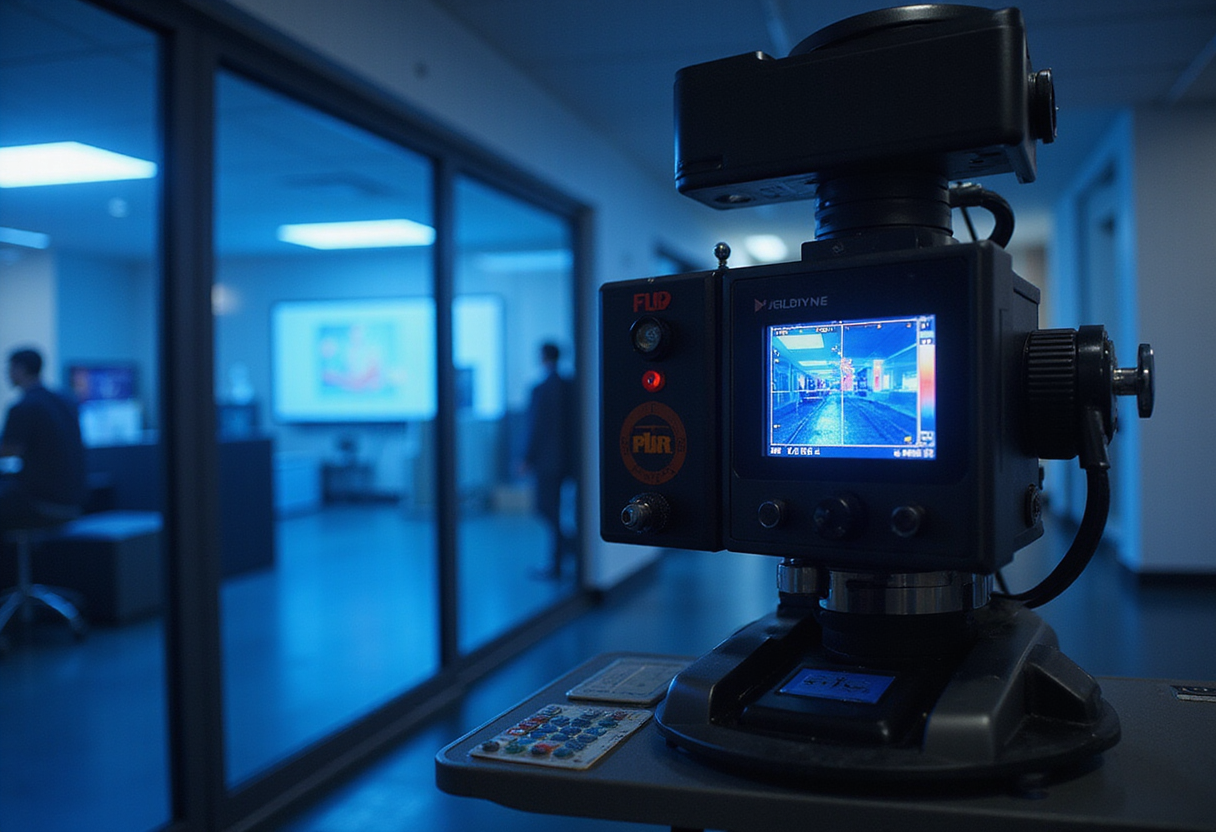
Teledyne FLIR has announced the A8481, a compact HD mid-wave infrared (MWIR, the 3–5 µm band) science camera built for researchers and engineers who need significantly more thermal detail without touching their existing workflows, optics, software, or infrastructure.
That positioning matters as much as the hardware itself. Thermal microscopy labs routinely sink years into fixture design, lens selection, and analysis pipelines around a single camera platform. A sensor upgrade that forces a requalification of the whole chain often isn't worth the resolution gain. Teledyne FLIR is betting the opposite: keep the ecosystem, swap the imager.
What is the A8481, exactly?
The camera sits in the company's science-grade lineup rather than its industrial monitoring range. HD resolution in the MWIR band means finer spatial sampling of microscopic heat sources — think semiconductor hotspot localization, materials characterization, and microelectronics failure analysis, the application territory where MWIR's sensitivity to mid-band emission pays off.
The vendor's core claim is straightforward: more thermal detail per field of view, delivered in a compact housing, inside the workflows researchers already run. Teledyne FLIR has not yet published full measurement specifications — NETD (noise-equivalent temperature difference, the smallest resolvable temperature signal), frame rates, or calibration details — so treat the performance picture as incomplete until the datasheet lands.
Takeaway: this is a workflow-compatibility play first, and a resolution play second.
Why HD resolution changes thermal microscopy
In microscopic thermal analysis, spatial resolution governs whether you can separate a real defect from its thermal halo. As feature sizes in advanced packaging and power devices shrink, a lower-resolution imager smears adjacent heat sources together, and the measurement quietly stops being quantitative.
Moving to an HD MWIR sensor lets an engineer resolve smaller, closer-together heat sources at the same magnification — or cover a wider field of view without giving up detail. The physics argument is familiar: mid-wave detectors offer strong sensitivity for objects near ambient-to-elevated temperatures, which is where most electronics failure work lives.
Takeaway: more pixels in the MWIR band means heat maps that remain trustworthy at the scale modern devices actually fail at.
What should buyers pin down?
The open questions are the ones any metrologist would ask before writing a purchase order:
- Net sensitivity (NETD) at the frame rates you actually use
- Calibration interval and traceability for absolute temperature work
- Optics compatibility — which existing lens families the HD sensor actually supports
- Software integration specifics, beyond the general compatibility claim
Teledyne FLIR's announcement frames the A8481 as a drop-in upgrade for established benches. Until independent labs report measured performance under stated test conditions, the prudence rule applies: verify the resolution gain survives your own optical stack, not just the vendor's demo scene.
The adoption question is whether research and failure-analysis labs will trade up to HD MWIR incrementally — or whether the missing published specs delay qualification cycles that methodology-driven teams can't compress.
via flir.com (Original)
Filed under
- mwir
- thermal-imaging
- teledyne-flir
- infrared-camera
- thermal-microscopy
More from Sophie Lindqvist
Show full bio
News editor covering regulation, policy and their impact on Instruments, test and measurement at Testbench Report.
72 articles
Application notes
- VISION 2026 Stuttgart: 100 Gbit/s Fiber Imaging and IP67 Smart Sensors
- VISION 2026 Stuttgart: 100 Gbit/s Imaging Heads a Bandwidth-Driven Agenda
- A3 Guide Lists Ten SWIR Camera Applications Across Three Industries
- Photonics Spectra Spring 2026 Highlights Cooling for Machine Vision Cameras
- Allied Vision Pushes Edge AI into VSWIR Spectral Band via Alecs