TB-6918 · REV F · Technical newsheet
Electronic TestDevice profile
Tektronix Claims First 8-Channel 25 GHz Oscilloscope
Tektronix claims the first oscilloscope combining eight channels with 25 GHz bandwidth. Full sample rate, noise floor, and pricing details remain unpublished.
By Sophie Lindqvist2 min read496 words
Features
- Tektronix announces an oscilloscope it calls the world's first with 8 channels and 25 GHz bandwidth.
- The 'world's first' claim is the vendor's own; no independent verification was reported.
- Sample rate, memory depth, noise floor, and pricing were not disclosed in the announcement.
- Whether 25 GHz holds with all 8 channels active simultaneously is not yet stated.
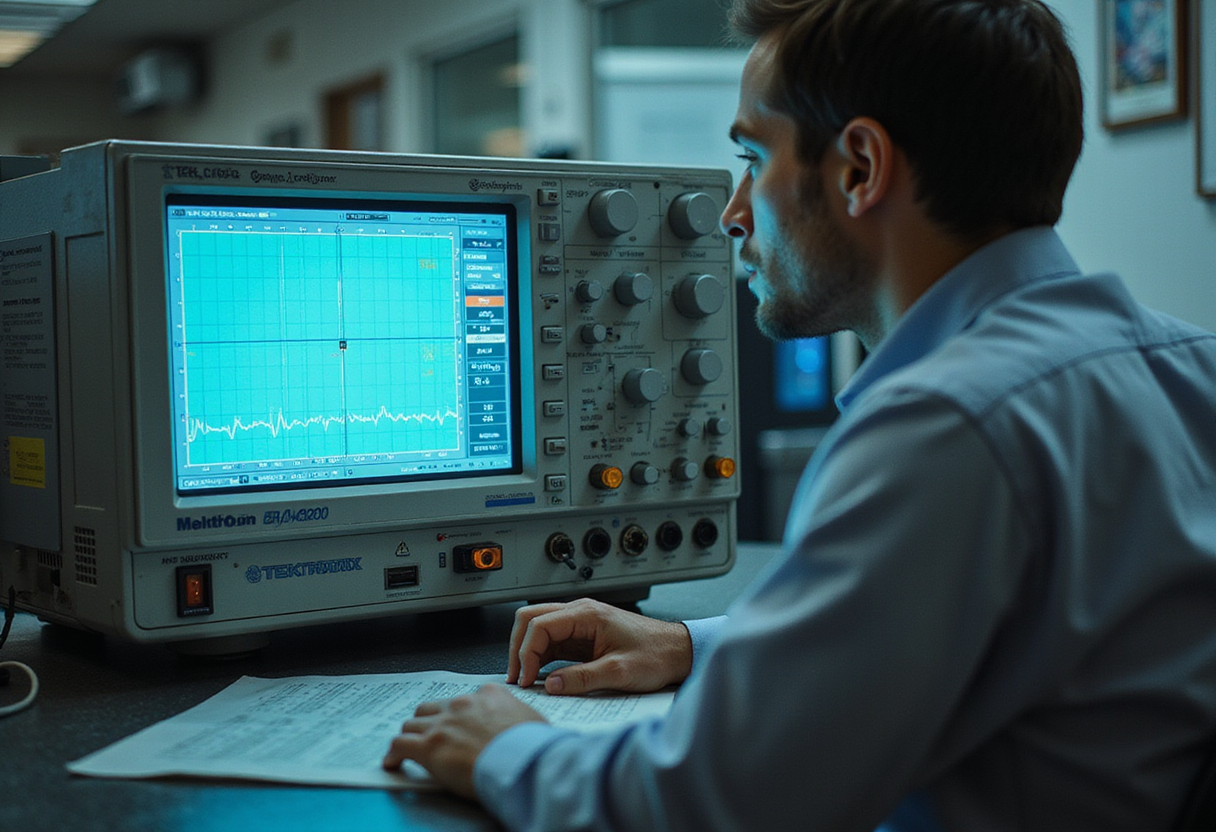
Tektronix has introduced an oscilloscope it describes as the world's first to combine eight channels with 25 GHz bandwidth in a single instrument. The claim of category precedence is the company's own; no independent verification accompanied the announcement.
What does 8 channels at 25 GHz change?
Channel count is the constraint that shapes how wide-bandwidth instruments get deployed. Eight synchronized acquisition channels at 25 GHz lets an engineer capture a full set of high-speed serial lanes, or a combination of power and signal rails, on one timebase — without distributing triggers and deskewing channels across multiple scopes.
Multi-scope setups carry a calibration and correlation burden that a single-chassis instrument removes. When eight channels share one sampler architecture and one clock, the inter-channel skew budget becomes an instrument specification the vendor warrants rather than a bench procedure the user must own.
Where the physics matters
At 25 GHz of analog bandwidth, the fifth harmonic of a 5 Gb/s NRI data stream falls inside the passband, which is the criterion most serial-standard compliance work assumes. For engineers characterizing multi-lane interfaces — where standards bodies define skew and crosstalk limits across lanes, not just per lane — capturing all lanes simultaneously is what makes the measurement physically meaningful. Sequential single-channel captures cannot resolve lane-to-lane timing relationships at picosecond scale.
What we don't know yet
The announcement as reported does not include the specifications that decide a purchase in this class:
- Sample rate per channel
- Analog bandwidth flatness and roll-off characteristics
- Memory depth and waveform capture rate
- Noise floor and effective number of bits at full bandwidth
- Pricing and availability date
- Whether the 25 GHz rating holds with all eight channels active simultaneously, a condition where many architectures derate
Each of these can shift a buying decision as much as the headline bandwidth figure. Until Tektronix publishes full datasheet parameters with stated test conditions, the measured-versus-claimed distinction remains open.
Who adopts it, and what does it compete against?
The obvious users are teams working on multi-lane high-speed serial standards, wide-bandwidth radar and coherent optical characterization, and power-integrity engineers who need correlated capture across many rails with fast edges. Tektronix competes here principally with Keysight and Rohde & Schwarz, both of which offer high-channel-count configurations — typically by stitching together multiple mainframes or via external synchronization.
If Tektronix's single-chassis claim holds, the competitive question becomes whether integrated eight-channel synchronization outperforms synchronized multi-instrument racks in skew, cost, and rack space. That comparison will need side-by-side bench data, not datasheet arithmetic.
The development raises a final compliance question: as serial standards push toward more lanes at higher per-lane rates, will test procedures and compliance suites be revised to require — or at least reward — simultaneous multi-lane capture rather than lane-by-lane measurement? An instrument class that makes simultaneous capture routine tends to pull the standards with it.
via Google News: Oscilloscopes and test equipment (Source)
Filed under
- tektronix
- oscilloscope
- high-bandwidth
- multi-channel-acquisition
- high-speed-serial
More from Sophie Lindqvist
Show full bio
News editor covering marketplaces and e-commerce at Testbench Report.
66 articles