TB-7026 · REV B · Technical newsheet
Machine Vision & InspectionDevice profile
Porsche installs AI-enabled robotic paint inspection cell
Porsche has added an AI-enabled robotic paint inspection system, per Vision Systems Design. The brief leaves sensor models, plants, and throughput unspecified, so the buying question is calibration discipline.
By Grace Kim3 min read593 words
Features
- Porsche has added an AI-enabled robotic paint inspection system, reported by Vision Systems Design
- The announcement names no plant, no sensor model, no throughput figure, and no calibration interval
- Automotive paint QA typically covers film thickness (80-140 µm), color match, gloss (ISO 2813), DOI (ASTM E430), and orange peel
- An AI classifier replaces fixed-threshold rule sets so the cell can flag gradual process drift between units
- Three open compliance questions remain: calibration cadence, master-panel drift limits, and AI model version control
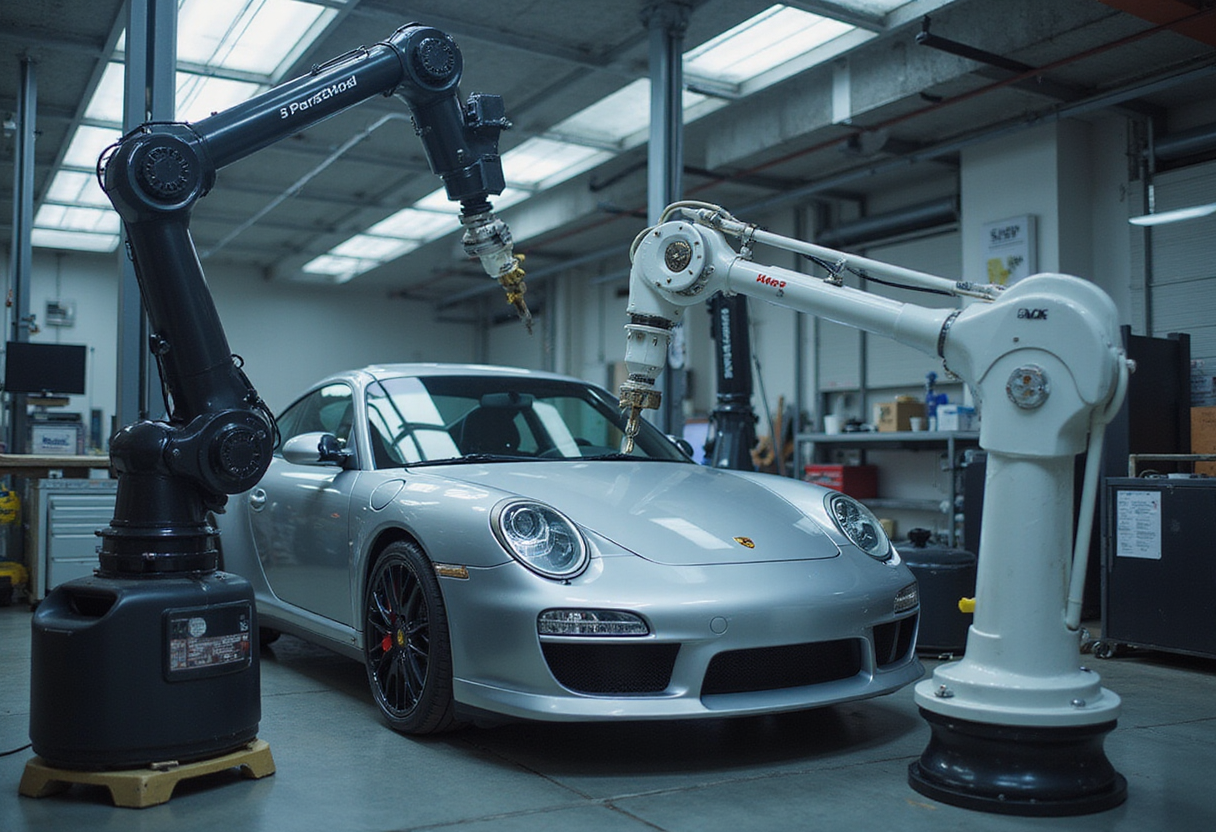
Porsche has added an AI-enabled robotic paint inspection system to its manufacturing operations, according to Vision Systems Design. The announcement is brief; the source does not name the plant, the sensor models, the cycle time, the resolution, or the calibration interval. With no published numbers, the buying decision turns on what an automotive paint-shop inspector actually has to measure, and what an automated cell has to prove before it can replace a human.
What a paint shop must measure
A finished body coat carries several independent quality dimensions that must hold panel-to-panel. Film thickness typically lands between 80 µm and 140 µm across basecoat and clearcoat. Color match must hit a master panel under a defined D65 illuminant. Gloss is read at 20° and 60° geometries per ISO 2813. Distinctness of Image (DOI) follows ASTM E430. Surface waviness — the long- and short-wave texture called orange peel — is graded against a reference scale. A trained inspector under a fluorescent booth can hold those judgments steady for minutes, not across an eight-hour shift; a robotic cell, in principle, can run the same suite on every unit.
What AI changes inside the cell
Conventional machine-vision paint gates compare measured features against fixed thresholds. Orange peel has historically been graded by an operator running a hand across the panel or by a handheld BYK Wavescan; an automated cell replaces the hand with a laser-triangulation or confocal profilometer and the eye with a regression model. The shift from threshold logic to a learned classifier lets the cell flag subtle deviations a rule set would miss — slow drift in a spray-booth atomizer, paint-cloud variation between two adjacent bodies — without a programmer rewriting the limits each shift.
The sensor stack in such cells typically combines:
- 2D color cameras under D65 lighting for spectral match
- 3D profilometers (laser line, confocal, or photometric stereo) for waviness
- Polarized imaging for clearcoat flow defects
- Robotic positioning that holds stand-off and incident angle constant across contoured panels
How that stack maps from vendor datasheet to measured field performance is the question the brief does not answer.
Where a metrologist will push back
Three compliance questions follow the announcement. ISO 2813 governs gloss geometry. ASTM E430 governs DOI. ISO 2808 governs film thickness. Each standard fixes the geometry, the calibration cadence, and the substrate preparation that an automated cell has to reproduce. A robotic arm holding a profilometer changes the angle of incidence panel-to-panel unless the motion planner enforces a fixed normal, so a metrologist will want to see the calibration routine: how often the cell re-runs a master panel, what drift limit triggers re-cal, and whether the AI model itself is version-controlled against that master. Porsche has not disclosed any of this in the Vision Systems Design piece.
A separation-of-concerns question follows. The same cell that flags a defect must feed the upstream paint process — gun flow, bell speed, booth airflow, flash time — with actionable feedback. A learned classifier that emits a probability score is useful for sorting; the production engineer needs a root-cause tag. Whether the system closes that loop or simply rejects the body is the practical question.
The source material contains no direct quotation from Porsche engineers, no throughput number, no plant name, and no sensor designation, so this rewrite cannot restate any. Buyers evaluating the cell should treat the announcement as a deployment signal and request the calibration certificate, the master-panel schedule, and the model version-control policy before signing off.
via Google News: Machine vision inspection (Source)
Filed under
- robotic-inspection
- paint-quality
- ai-inspection
- surface-metrology
- automotive-manufacturing
More from Grace Kim
Show full bio
Correspondent covering consumer brands and retail at Testbench Report.
67 articles
Application notes
- senswork to Demo AI Surface Inspection and 3D QC at IMTS 2026
- Industrial Machine Vision Cameras Headed for $5.61B by 2035
- Machine Vision Cell Cuts Insert Defect Miss Rate to 11.8%
- SICK Launches Nova AI-Powered 3D Machine Vision for Industrial Inspection
- IMTS 2026 reframes machine vision for manufacturing