TB-1197 · REV E · Technical newsheet
Machine Vision & InspectionDevice profile
Asylon's MARIA Inspects Air Force Aircraft With Autonomous Dog-Drone Teams
The U.S. Department of War awarded Asylon a multi-million-dollar contract for MARIA, a drone-plus-quadruped system already inspecting C-5, C-17 and C-130 aircraft at Warner Robins ALC in Georgia.
By Olivia Hart4 min read742 words
Features
- MARIA development took under a year; the new drone hardware was finished and flight-tested in about six months.
- Asylon has completed 400,000+ inspection and security missions across infrastructure, logistics, government and commercial sectors.
- The system is operational at Warner Robins Air Logistics Complex, Georgia, inspecting C-5, C-17 and C-130 aircraft.
- The quadruped required a camera three times the size of Asylon's standard pup pack plus a new LIDAR system.
- Passive cooling proved inadequate for the dog on hot tarmac; Asylon added fans to heat sinks for active cooling.
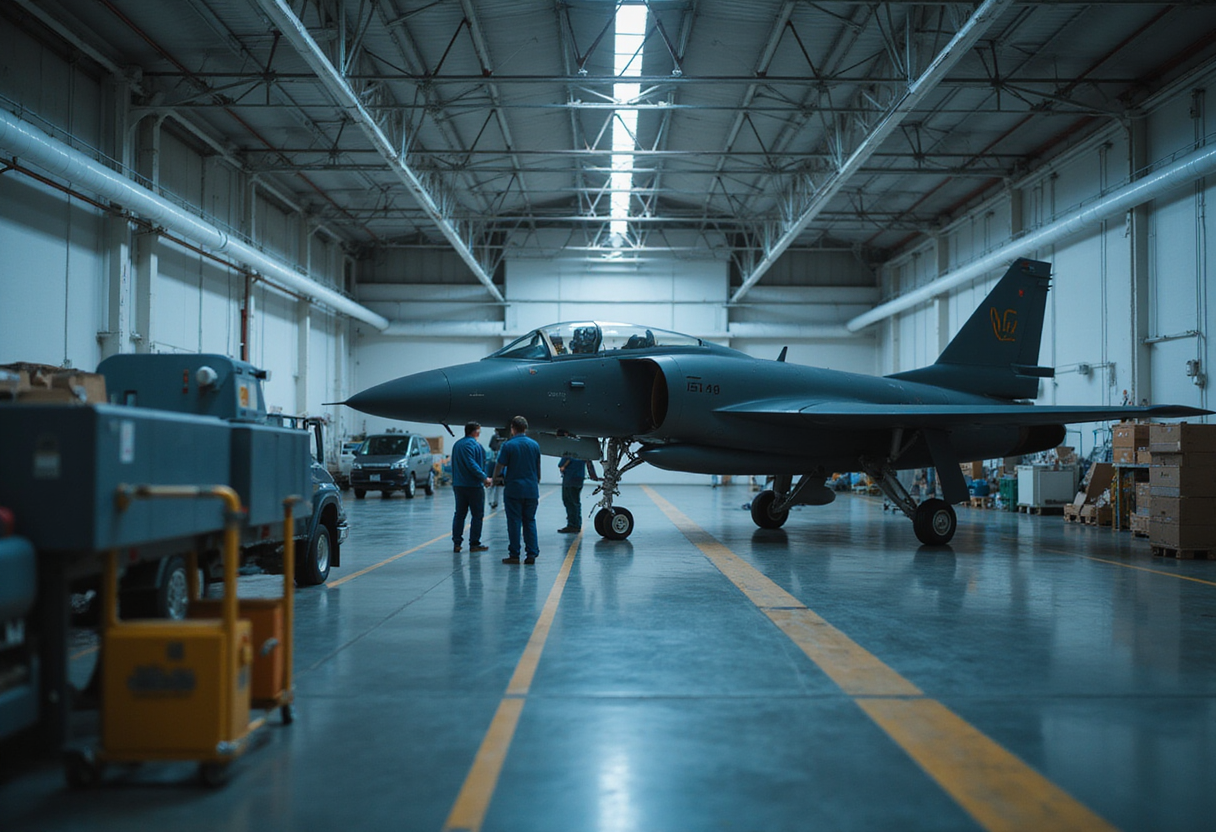
The U.S. Department of War has awarded Asylon a multi-million-dollar contract for MARIA — Multi-modal Autonomous Robotics for Inspection of Aircraft — a system already inspecting C-5 Galaxy, C-17 Globemaster and C-130 Hercules airframes at the Warner Robins Air Logistics Complex in Georgia. Asylon built it on the back of 400,000-plus inspection and security missions already flown or driven for infrastructure, logistics, government and commercial clients, and it delivered the working system in under a year, with the new hardware platform finished and flight-tested in roughly six months.
The deployment marks a maturation step for drone-based inspection, which began examining bridges, wind turbines and transmission lines about a decade ago. MARIA pairs a flying drone with a ground-based quadruped "dog" to capture the full exterior of aircraft that Asylon Chief Technology Officer and Co-Founder Adam Mohamed puts at over $100 million each.
What does full autonomy mean here?
Once an inspection is scheduled or manually triggered, the dog leaves its "doghouse" and the drone leaves its "nest." Both navigate to the specified aircraft, avoiding obstacles via LIDAR-based localization, and gather visual data until the day's tasks are complete — returning autonomously for recharging or battery swaps as needed.
The two platforms split the data collection. The drone captures top-down views of areas a technician on the ground struggles to reach; the dog covers the fuselage sides, landing gear and wing undersides.
"We are now taking it to the next level with a multimodal and fully autonomous remote methodology," said Mohamed, an MIT graduate in aerospace, aeronautical and astronautical engineering. "We're flying and walking next to aircraft worth $100+ million, achieving the equivalent detail of human eyes three feet away."
How does the sensor fusion work?
LIDAR point-cloud data handles obstacle avoidance and localization so the cameras hold the correct distance from the airframe. Telemetry, metadata and imagery must be synchronized and integrated into one dataset, from which Asylon builds a digital twin through sensor fusion. The company's DroneIQ software stack serves as a "single pane of glass" for operators and maintainers.
The output has to be decision-grade: resolution must be high enough that a maintenance engineer can determine which components need repair or replacement and which do not. Point-cloud and imagery data must map onto each other, repeatably and consistently — and the system must function reliably at the ambient temperatures of a sun-baked tarmac.
What did the hardware trade-offs cost?
Asylon started from a stock security drone and added a new payload system with a specialized gimbal for accurate image capture at range. Engineers had to work out how the drone's nose could carry the weight, supply additional power, and still meet flight-performance targets, with extra wire runs and stabilization layered in.
The quadruped required similar surgery. "We had to basically retool our security 'pup pack,' rip off the front third of it to put on a new LIDAR system and a camera that is three times the size of our pup pack onto the back of the unit," Mohamed said.
Camera incidence varies by target — 0 degrees from vertical for a wing bottom or landing gear, 90 degrees elsewhere — so the enclosure had to protect the camera while allowing those angles.
How do you hold a camera steady on a walking robot?
The quadruped, for all its smooth gait, is at bottom "basically punching the ground with its feet," as Mohamed put it. The superhigh-resolution camera needed a comprehensive vibration isolation system, validated through a series of experiments and tests. The drone proved harder still to stabilize, owing to motor vibration and added mass.
Thermal loads were the dog's biggest problem. Initial passive-cooling models "didn't reflect reality" once tarmac heat and LIDAR output were combined, so Asylon moved to active cooling — fans added to conventional heat sinks. "The fans were critical," Mohamed said.
Why does modularity matter?
Asylon designed both platforms modularly from the outset, expecting mission sets to expand. Many competing systems, Mohamed noted, are optimized for a single payload or camera, which limits rapid reconfiguration for new requirements.
The open question for Air Force maintainers is whether fully autonomous multimodal inspection can hold the repeatability and traceability that military maintenance documentation demands — and whether a drone-and-dog digital twin will satisfy the inspectors who must sign off on a $100 million airframe.
via Machine Design (Source)
Filed under
- autonomous-inspection
- drone-robotics
- sensor-fusion
- digital-twin
- aircraft-inspection
More from Olivia Hart
Show full bio
Market editor covering media and advertising at Testbench Report.
63 articles
Application notes
- IMTS 2026 reframes machine vision for manufacturing
- Machine Vision's Post-IMTS 2026 Question: System, Not Sensor
- AI4RVI's Edgevision Puts 1080p Tube Inspection on an NVIDIA Jetson
- Emesent Lands $2M Grant for GPS-Denied Robotics Autonomy Platform
- SICK Launches Nova AI-Powered 3D Machine Vision for Industrial Inspection