TB-4750 · REV F · Technical newsheet
Industrial IoT & MonitoringDevice profile
NIST's Safe Step AI Ranks Fire Exits by Toxic-Gas Dose, Not Distance
NIST's Safe Step reinforcement-learning model picks fire evacuation routes by minimizing cumulative toxic-gas dose, forecasting fire growth to drive dynamic exit displays. Deployment seen in 5–10 years.
By Grace Kim4 min read844 words
Features
- Paper published online Jan. 15, 2026, in the Journal of Building Engineering; DOI 10.1016/j.jobe.2025.115132.
- Safe Step uses reinforcement learning and minimizes the fractional effective dose (FED) of toxic gases rather than shortest path.
- The current model works only for single-story floor plans; multilevel and multi-agent versions are future work.
- Researchers estimate technologies like Safe Step could appear in five to 10 years, pending regulatory approval and reliability testing.
- In test cases against a traditional algorithm, including a complex single-level structure, the model consistently gave safe evacuation routes.
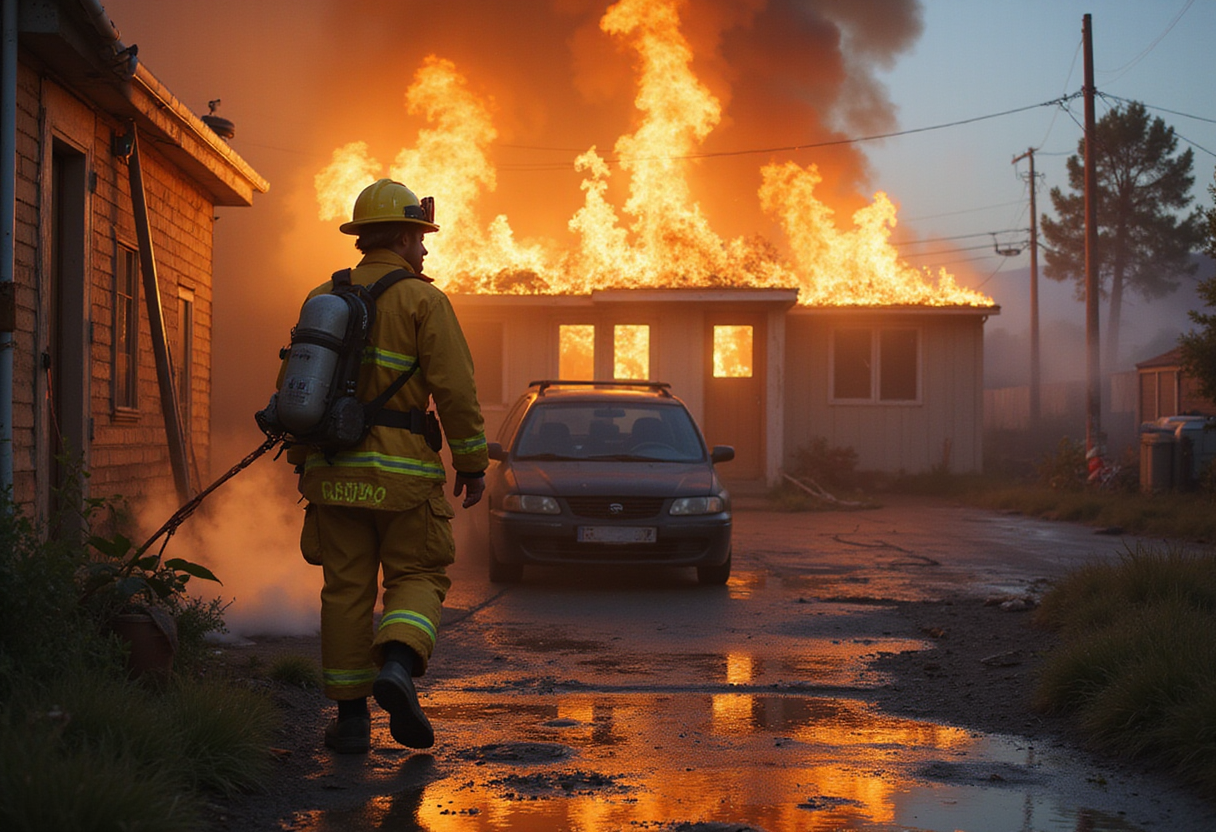
A NIST-led team has built an evacuation model that picks routes by minimizing a building occupant's cumulative exposure to toxic gases rather than by finding the shortest path to an exit. The model, called Safe Step, uses reinforcement learning trained on fire-simulation data and could reach commercial deployment in five to 10 years, the researchers estimate.
Hongqiang "Rory" Fang, a research associate at NIST and first author of the paper, said: "Fires can grow and spread. Our model forecasts how the fire is evolving and can help update emergency exit displays to direct people toward the safest exit."
The work, published online Jan. 15, 2026, in the Journal of Building Engineering (DOI: 10.1016/j.jobe.2025.115132), comes from Fang, NIST mechanical engineer Wai Cheong Tam, Ruggiero Lovreglio, Md. Ismail Siddiqi Emon and Michael Xuelin Huang.
What does the model actually optimize?
The decisive engineering choice is the objective function. Safe Step minimizes the fractional effective dose (FED) of toxic gases — a standard fire-safety metric that accumulates a person's hazard exposure over time rather than sampling it at one instant. A route that looks acceptable now may become lethal if smoke and combustion products build faster than an evacuee can walk it. Traditional shortest-path algorithms evaluate only current building conditions and ignore this cumulative hazard along the route. Safe Step accounts for how toxic-gas exposure changes as the occupant moves, and it selects the route with the lowest FED.
NIST mechanical engineer Wai Cheong Tam framed the design question directly: "We asked ourselves, 'Can we build a better algorithm that predicts how the fire evolves, and in a way that helps save more lives?'"
How does it work in deployment?
The training pipeline combines two inputs: the building floor plan, from which the model learns evacuation routes, and output from a NIST fire simulation tool, from which it learns how a fire develops over time in that layout. During training, Safe Step forecasts how the fire will affect occupants and adjusts its route guidance accordingly.
In deployment, the model does not run a fire simulation in real time. It consumes live sensor data from the building — temperature, air quality and other environmental measurements that "smart" buildings already collect — and continuously updates its recommendations as conditions change.
The intended output device is the dynamic emergency exit display, a technology now under test in some smart buildings. These electronic signs can show whether a given exit is safe to use or point arrows toward a safer alternative.
How did the model perform against conventional routing?
The team tested Safe Step against a traditional algorithm in two comparison cases and then moved to a more complex single-level building structure. Across these tests, the model consistently produced safe evacuation routes, the researchers report.
The paper's illustrative failure case for conventional routing is concrete. A fire starts in a room across a hallway, and a small amount of smoke enters the hallway. A shortest-path algorithm sends the occupant across the hallway toward the nearest exit. If the fire grows during that crossing, the nearest exit may become unusable by the time the occupant approaches it. Safe Step anticipates the change and supplies data that directs the occupant to a more distant but safer exit at the opposite end of the hallway.
Note the scope limits of the published results: the current model handles single-story floor plans only. Test performance in simulated structures does not yet establish behavior in multilevel geometries or with crowds of interacting evacuees.
What comes next?
The researchers' roadmap has two stages:
- Multilevel buildings. Extend the model so an evacuee can move up or down a floor in addition to turning left or right down a hallway.
- Multiple agents. Build an AI system in which each agent corresponds to a different building occupant. Agent-to-agent interaction would let the model adapt to real evacuation dynamics — for example, congestion bottlenecks that form at a single entrance when many people exit at once.
The multi-agent version could also coordinate evacuee routing with access points for firefighters entering the building. That coordination would aid firefighting and the rescue of vulnerable individuals, including older adults, children and people with disabilities.
The adoption question
The five-to-10-year deployment estimate carries conditions the researchers state plainly: regulatory approval, reliability testing and integration with existing building safety systems. Dynamic exit displays themselves are still in testing. Fang put the work in perspective: "This research is still in the early R&D stage, but it represents an important step toward intelligent firefighting where effective use of advanced technologies can protect property and save lives."
For building-code bodies and fire-safety engineers, the open question is whether an FED-minimizing, forecast-based routing algorithm can be validated to a standard that regulators will accept for life-safety signage — the same class of question that governed the adoption of NIST's earlier contributions to smoke alarms and firefighter gear over the institute's century-plus of fire-safety research.
via pages.nist.gov (Original)
Filed under
- reinforcement-learning
- fire-safety
- smart-buildings
- nist
- evacuation-modeling
More from Grace Kim
Show full bio
Correspondent covering consumer brands and retail at Testbench Report.
67 articles
Application notes
- Nature paper applies reinforcement learning to IIoT streaming maintenance
- Petro-SIM 7.7 Pairs First-Principles Simulation With Embedded ML
- NIST Renames AI Safety Consortium, Widens Scope to Measurement and Adoption
- One-Class Anomaly Detection Screens New Lines Before Failure History Exists
- Cognex Brings AI Tools to Industrial Machine Vision: ARC Report